Our Progress in 2025

In 2025, we made it easier for millions of travelers to experience the world, driven by our commitment to connecting people and places. While the travel industry has nearly fully recovered five years after the start of a global pandemic, complex sustainability challenges remain.

Emission Reductions

On our way to achieving net-zero emissions by 2040, we are working to reduce our Scope 1 & 2 emissions by 95% and our Scope 3 emissions by 50% (both against a 2019 baseline) by 2030.
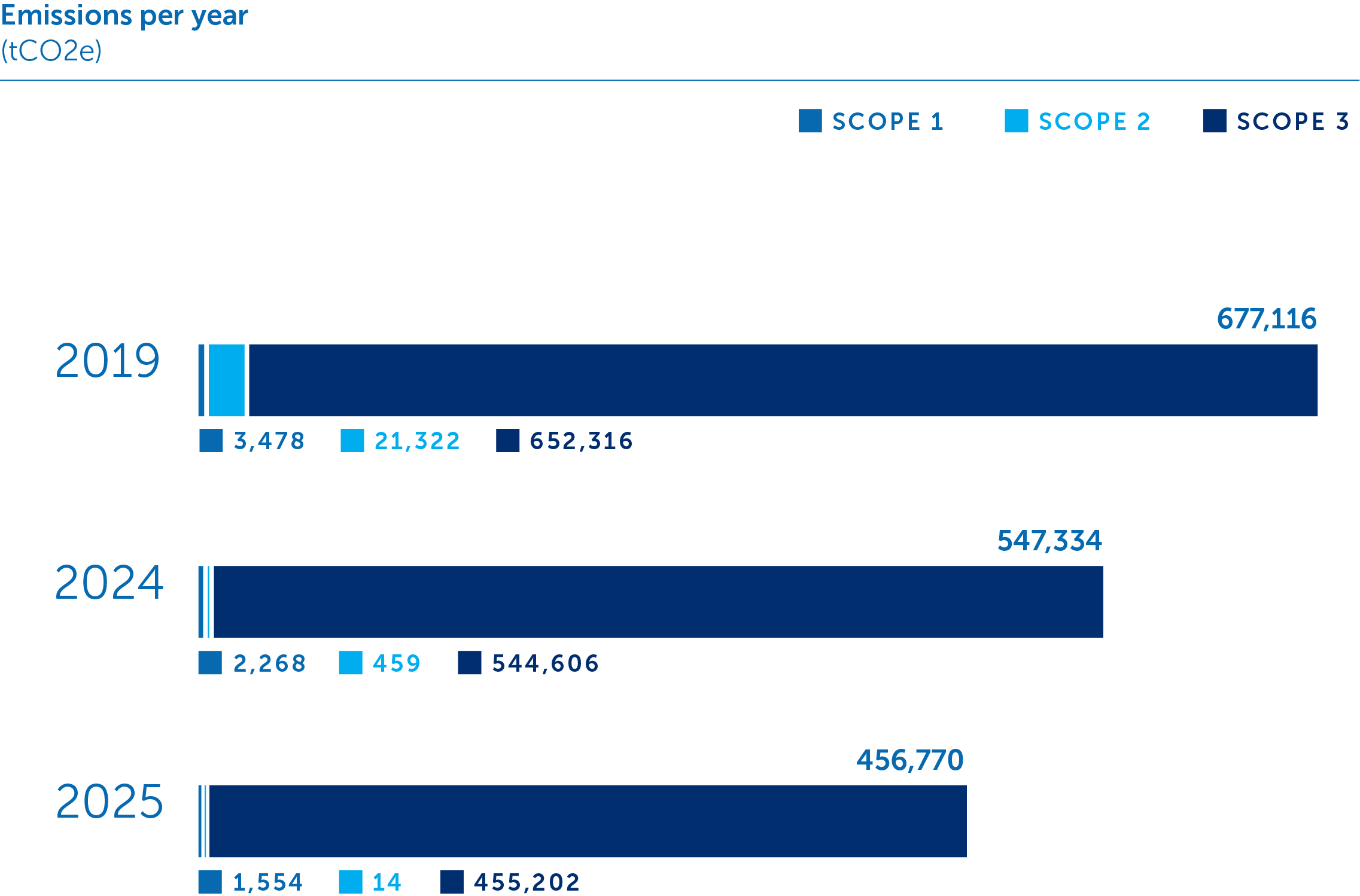
Emissions chart

Scope 1 & 2 emissions
As of year-end 2025, we have reduced our absolute Scope 1 & 2 emissions by 94%, against the 2019 baseline, reflecting continued progress toward our target and bringing us closer to our 2030 goal. By conducting in-depth reviews of equipment and technology in buildings leased by Booking Holdings and its brands, we created a real estate decarbonization roadmap that leverages energy efficiency upgrades, electrification and improved cooling technologies. We also maintained 100% renewable electricity sourcing across our offices through the purchase of unbundled energy attribute certificates (EACs), of which 95% are purchased within the country where the electricity is consumed.⁴

Scope 3 emissions
Our target is to reduce our absolute Scope 3 emissions by 50% against a 2019 baseline by the end of 2030 and by 90% by 2040. Emissions in this scope account for 99% of all of Booking Holdings’ reported GHG emissions and include the indirect emissions generated within our supply chain. In 2025, we strengthened the quality and precision of our Scope 3 greenhouse gas emissions inventory by incorporating activity-level data for a portion of our marketing spend. Applying this improved methodology resulted in our 2025 Scope 3 emissions measuring 30% lower than our 2019 benchmark year, and a 16% year over year reduction compared to 2024.


“The updates made in 2025 to our Scope 3 emissions data are helping us better understand the activities that drive those emissions. We’re now continuing to work with our partners to expand capabilities and empower operations with emissions data that is as precise as possible.”

Ashe Patankar, Vice President, Procurement, Booking Holdings

Human Rights Support

Students

Our approach to human rights is driven by the UN Guiding Principles on Business and Human Rights and the OECD Guidelines for Multinational Enterprises on Responsible Business Conduct. In 2025, a combination of internal teams and external human rights experts continued enhanced property-by-property assessments in conflict-affected areas to identify and understand relevant potential human rights impacts of listings in these areas and examine how our company can seek to avoid contributing to those impacts. At Booking.com, we also continued our partnerships with Stop the Traffick, It’s a Penalty and Tech Against Trafficking, strengthening industry collaboration to combat human trafficking.

“In 2025, we helped to deliver anti-human trafficking material to more than 250 million people. Training webinars and other digital campaigns hosted by Booking.com also provided educational resources related to the prevention of human trafficking to over 240,000 accommodation partners.”

Jennifer Easterday, Head of Human Rights, Booking.com

Volunteering

People on bridge

Volunteering and other impact-driven efforts that align with our mission and vision are key levers for us to support positive change outside of our organization and industry. Our employees have access to paid time off for volunteering. In 2025, over 6,000 employees contributed to organizations and causes that matter to them, spending over 38,000 hours giving back to communities.

Employee Resource Groups

Cheerful Friends

Across our brands, we have 22 Employee Resource Groups (ERGs), which are open to all employees. These groups work to promote an inclusive workplace by providing community and support as well as awareness and education. In 2025, more than 7,000 employees participated in ERGs, and over 150 ERG-led events took place.

Travel BHI - father and son on the beach

We focused further on supporting our accommodation partners in their adoption of third-party sustainability-related certifications and launched a new product to help them obtain these certifications. As a result of these efforts, we increased the number of accommodations with third-party sustainability certifications on our platforms by 22% in 2025, contributing to more than 100 million as-booked room nights (ABRN) at accommodation partners displaying such certifications.

We continue to work with our partners and the broader industry in coming together around certification methodologies.

Partnerships

Hotel room

In order to support and accelerate positive change in our industry and to help preserve destinations, we continued to engage with a variety of organizations, including our peers, partners and others, to support research, investments and partnerships.

“In 2025, Agoda introduced the Sustainable Tourism Impact Fund in partnership with the World Wide Fund for Nature (WWF) and the UnTours Foundation. The impact fund offers significant capital and mentorship to micro, small, and medium-sized enterprises in the tourism sector. The aim is to support businesses in fostering local growth that benefits communities and contributes to resilient destinations.”

Damien Pfirsch, Chief Commercial Officer, Agoda

FOOTNOTES
1. Net Zero means reducing GHG emissions by at least 90% by 2050 at the latest, and investing in carbon removal projects to offset remaining emissions in line with science-based standards.

2.SBTi is an independent, multi-stakeholder partnership established to develop a global standard for net-zero targets and assist companies in creating science-based frameworks for emissions reduction.3. These (approximately 500) vendors represent roughly 87% of our annual spend.

3.From Booking.com’s Travel and Sustainability Report 2025

4.An energy attribute certificate (EAC) is a contractual instrument that conveys information (attributes) about a unit of energy, including the resource used to create the energy and the emissions associated with its production and use.

5.Scope3 emissions are the result of activities from assets not owned or controlled by the reporting organization, but that the organization indirectly affects its value chain.

6.The methodological improvement only applies to 2025 and not earlier years.